PalaeoLab Consultancy
PalaeoLab is a specialist palaeoenvironmental consultancy providing a comprehensive range of laboratory and analytical services to investigate past environments, landscapes, climates, and ecological change.
Our work supports Commercial archaeological, geological, environmental services, and academic research, using biological, sedimentological, geochemical, and chronological evidence preserved within sediments and archaeological deposits.
Our services include the analysis of diatoms, pollen and spores, phytoliths, plant macrofossils, macro- and microcharcoal, cryptotephra, stable isotopes, magnetic susceptibility, particle size, and sedimentology using thin sections. We provide services across the full analytical process, from sample preparation and initial assessment through to detailed identification, quantification, laboratory analysis, and interpretation of results.
By combining multiple analytical techniques, PalaeoLab can build detailed reconstructions of past environments and investigate changes in vegetation, climate, hydrology, fire activity, sedimentary processes, land use, and human–environment interactions through time. Our flexible approach allows projects to be tailored to individual research questions, whether a preliminary assessment is required or a comprehensive multi-proxy investigation is needed.
PalaeoLab works collaboratively with researchers, archaeologists, environmental consultants, heritage professionals, and other organisations to provide clear, robust, and scientifically informed results. We aim to make complex palaeoenvironmental data accessible and meaningful, helping our clients develop a deeper understanding of past environments and the processes that have shaped them.

PalaeoLab is affiliated with The Centre for Quaternary Research (CQR). The Quaternary is a geological time period covering the last 2.6 million years, up to and including the present. It is characterised by cycles of long term and abrupt climate change, leading to repeated glaciations followed by retreat. It is also the period in which our own species evolved. The CQR is one of the leading centres studying the interaction between climate, environments, people and other biota within the Quaternary. Our research aims to understand environmental, human and biotic responses to past changes in climate. These data allow us to test models relating to the drivers of past changes, and to infer likely responses to future changes in climate and environment in an anthropogenically warmed world. To understand past changes, CQR members: (i) produce high resolution records of climates and environments (particularly from lakes which can preserve seasonally or annually resolved records); (ii) generate new models for the chronology and nature of early human and animal dispersal and behaviour; (iii) work across glacial, fluvial, marine and dryland systems to quantify past landscape responses to climate change and (iv) apply the knowledge gained to present-day ecosystem management issues (e.g. carbon sequestration by wet woodlands), industrial agenda and policy development for the benefit of a range of stakeholders.
Services
Proxy Analysis
Tephra
Cryptotephra, microscopic volcanic ash particles, can be widely dispersed across landscapes and are exceptionally well preserved within sediments. Their distinctive geochemical signatures make them valuable chronological markers for geological, archaeological, and environmental research. Tephra layers can be used to correlate sediment sequences within and between sites, providing a robust means of establishing chronological relationships. As an independent dating tool, tephrochronology can complement other dating methods and help overcome some of the uncertainties and limitations associated with techniques such as radiocarbon dating.
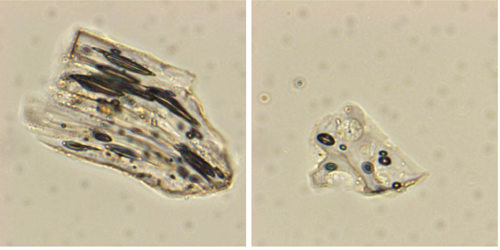
PalaeoLab offers a comprehensive range of tephra analysis services, from initial cryptotephra investigations and identification through to detailed geochemical analysis, correlation, and palaeoenvironmental interpretation.
Phytoliths
Phytoliths are microscopic silica structures formed within and between[HJ1] the cells and tissues of plants. These can be exceptionally well preserved in sediments and archaeological deposits, including those not otherwise suitable for pollen and plant macro analysis such as dry, alkaline environments, and those low in organic matter. Their distinctive shapes and characteristics can provide valuable information about past vegetation, environmental conditions, and landscape change. Phytolith analysis can be used to investigate vegetation communities, changes in plant abundance and distribution, land-use practices, and aspects of human interaction with the environment, including agriculture and cultivation.
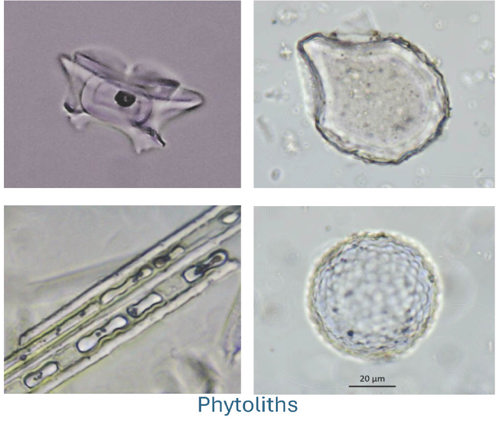
PalaeoLab offers phytolith analysis from sample preparation and extraction through to identification, quantification, and interpretation. Results can be used alongside other palaeoenvironmental and archaeological evidence to reconstruct past vegetation and provide insights into environmental and land-use change through time.
Diatoms
Diatom frustules are exceptionally well preserved within sediments, making them valuable indicators for reconstructing past aquatic environments across both marine and freshwater systems. Diatom investigations can provide insights into past climatic shifts, ancient coastlines, and the hydrological history of lake systems.
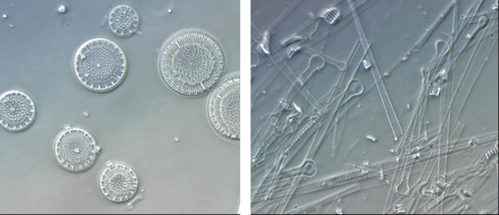
PalaeoLab offers a range of diatom analysis services, tailored to meet different research requirements. These include a general assessment of diatom presence and activity, accompanied by interpretation, through to comprehensive investigations involving detailed species-level analysis and in-depth palaeoenvironmental interpretation.
Pollen and spores
Pollen and spores are highly resistant biological remains that can be exceptionally well preserved within sediments. Analysis of pollen and spore assemblages can provide insights into changes in vegetation communities, climate, biodiversity, and landscape development through time. They can also provide evidence for human interactions with the environment, including agriculture, woodland clearance, land management, and changes in land use.
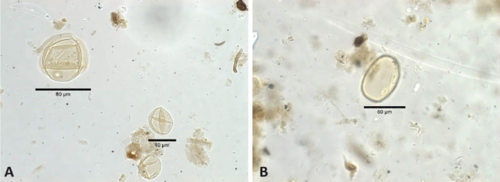
PalaeoLab offers both initial overview and full comprehensive pollen and spore analysis, from sample preparation and extraction through to identification, quantification, and interpretation.
Plant macrofossils
Plant macrofossils, including seeds, wood, leaves, fruits, and other larger plant remains preserved within sediments, can provide detailed information about past vegetation and environmental conditions at a more localised scale than pollen analysis. Because these remains are often derived from plants growing close to the site of deposition, they can provide valuable evidence for local habitats, vegetation communities, and changes in land use and environmental conditions through time. Organic materials such as macrofossils are also suitable for radiocarbon dating, allowing ecological and environmental changes to be placed within a robust chronological framework.
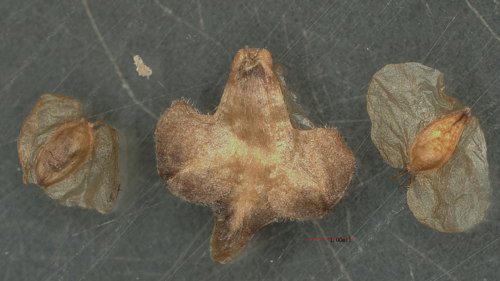
PalaeoLab offers plant macrofossil analysis, including the identification and interpretation of preserved plant remains.
Stable Isotope Analysis
Oxygen and carbon isotope analysis provides valuable insights into past environments and ecological change. Isotopic data can be used to reconstruct vegetation types and environmental productivity, investigate animal movements and dietary patterns, and monitor changes in environmental conditions through time.
PalaeoLab offers sample preparation for a range of oxygen and carbon isotope applications, alongside interpretation of analytical results. Our services can support the reconstruction of past ecological conditions and provide a deeper understanding of environmental and biological change through time.
Charcoal
Macro and microcharcoal analysis provides valuable insights into the frequency, intensity, and history of past fire activity. Charcoal records can help reconstruct changes in fire regimes and provide evidence for human interactions with the landscape, including deforestation, agricultural and crop management practices, and changes in ecosystem resilience.
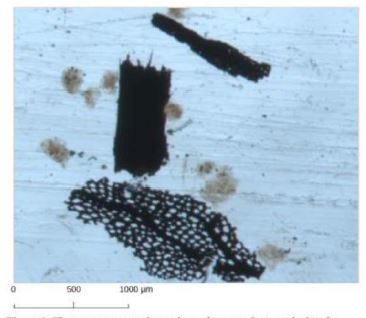
PalaeoLab offers comprehensive charcoal analysis and interpretation, from the identification and quantification of charcoal particles through to detailed investigations of past fire activity and its wider environmental impacts.
Foraminiferal assemblages and isotopes
Macro and microcharcoal analysis provides valuable insights into the frequency, intensity, and history of past fire activity. Charcoal records can help reconstruct changes in fire regimes and provide evidence for human interactions with the landscape, including deforestation, agricultural and crop management practices, and changes in ecosystem resilience.
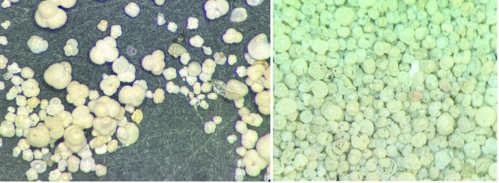
PalaeoLab offers comprehensive charcoal analysis and interpretation, from the identification and quantification of charcoal particles through to detailed investigations of past fire activity and its wider environmental impacts.
Soil and sediment analysis
Thin Section – micromorphology slide preparation and analysis
Thin-section analysis provides detailed information on the composition, texture, structure, and formation of sediments at a microscopic scale. Examination of sediment thin sections can provide information on individual mineral and organic components, grain characteristics, microstructures, depositional features, and evidence of post-depositional processes. This can help reconstruct sedimentary environments and provide insights into processes of transport, deposition, alteration, and environmental change through time.
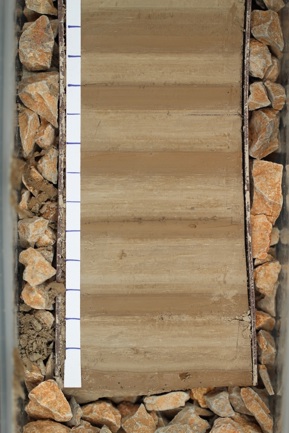
PalaeoLab offers thin-section preparation and detailed sedimentological analysis. Results can be integrated with other sedimentological and palaeoenvironmental analyses to provide a comprehensive interpretation of sediment formation, depositional environments, and subsequent environmental change.
Particle size analysis and sortable silt
Particle size analysis provides is useful for understanding the processes of sediment transport, deposition, and weathering through time. Variations in grainsize and sediment composition can be used to reconstruct past climatic and environmental conditions, including gradual environmental changes as well as more abrupt shifts in climate and depositional regimes.
PalaeoLab offers comprehensive particle size analysis, including the quantification of sand, silt and clay fractions, determination of average grain size, and detailed sediment descriptions for each sample analysed. Results can be accompanied by full interpretation, providing insights into sedimentary processes and changes in past environmental conditions.
Magnetic susceptibility analysis
Magnetic susceptibility analysis provides a rapid and non-destructive method for investigating changes in the magnetic properties and composition of sediments. Variations in magnetic susceptibility can reflect changes in sediment source, weathering, erosion, depositional processes, and environmental conditions through time.
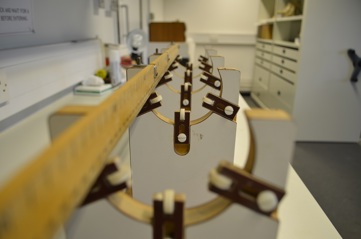
PalaeoLab offers magnetic susceptibility analysis of sediment sequences and individual samples, with results interpreted alongside other sedimentological and palaeoenvironmental evidence. This can provide valuable insights into sediment provenance, depositional processes, and environmental change, including both gradual transitions and more abrupt shifts through time.
Organic and calcium carbonate analysis of sediments
Sortable silt analyses of marine sediments are also offered via analysis on the Malvern Mastersizer which can be used to reconstruct the energy and flow speed of the ocean currents flowing over the coring site at a particular time. This additional analysis requires processing to remove the organic and silicate fractions of marine sediments before the sortable silt can be conducted, but can produce reconstructions of deepwater current speed.