Dr Thomas Jannaud
The magnetorotational instability (MRI) plays a crucial role in the evolution of many types of accretion discs (and of protoneutron stars). It controls the accretion onto the central object by driving turbulence, but also enables the launching of magnetised winds and jets. The MRI is most often studied using ideal magnetohydrodynamic (MHD) simulations of accreting discs. I will first present some generic results on the MRI and some issues with its use in MHD simulations.
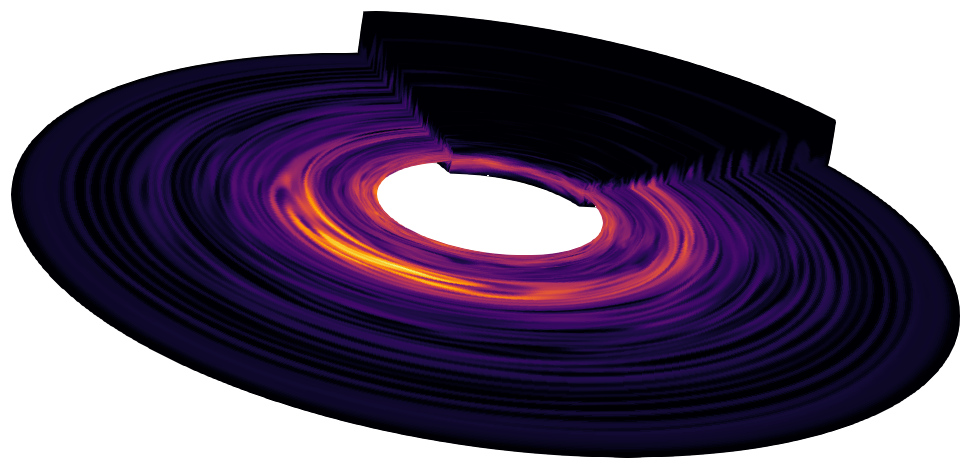
I will then focus on the peculiar case of protoplanetary discs. Their study has seen tremendous progress in the past decades, spearheaded by many observations in the radio and infrared bands (ALMA, SPHERE, GRAVITY...). In the inner regions of those discs lies a transition between an inner, MRI-turbulent zone, and an outer, laminar zone. This transition is a prime location for the accumulation of solids contained in the disc. That accumulation is of particular interest, as it is the first step of planet formation. I will show results extracted from 3D global MHD simulations of the inner regions of protoplanetary discs. Those simulations include non-ideal MHD effects and the presence of solids. They show a quick pileup of dust at the aforementioned transition (see image below). I will also highlight the influence of magnetised winds, as well as that of vortices induced by the Rossby-Wave Instability.