Dr Michael Williams
Bayesian inference underpins modern astronomical discovery, yet it is often computationally intensive, particularly in gravitational-wave astrophysics, where growing event catalogs must be analyzed under increasingly complex models.
In this talk, I will show how machine learning can accelerate Bayesian inference while remaining compatible with existing analysis pipelines. I will first describe how normalizing flows can be used as drop-in replacements within nested sampling, improving sampling efficiency and robustness without changing the underlying inference framework. These advances enable faster parameter estimation and model comparison with minimal disruption to established workflows.
I will then introduce new approaches based on Sequential Monte Carlo (SMC) that enable more flexible inference strategies. In particular, I will present Accelerated Sequential Posterior Inference via Reuse (ASPIRE), a framework that transforms existing posterior samples and evidence estimates into unbiased results under alternative models without rerunning the full analysis. By combining normalizing flows with SMC, ASPIRE enables fast, statistically robust reanalyses and scalable studies across large gravitational-wave event catalogs.
I will conclude by discussing the advantages, limitations, and broader applicability of these methods across astronomy and other data-intensive sciences.
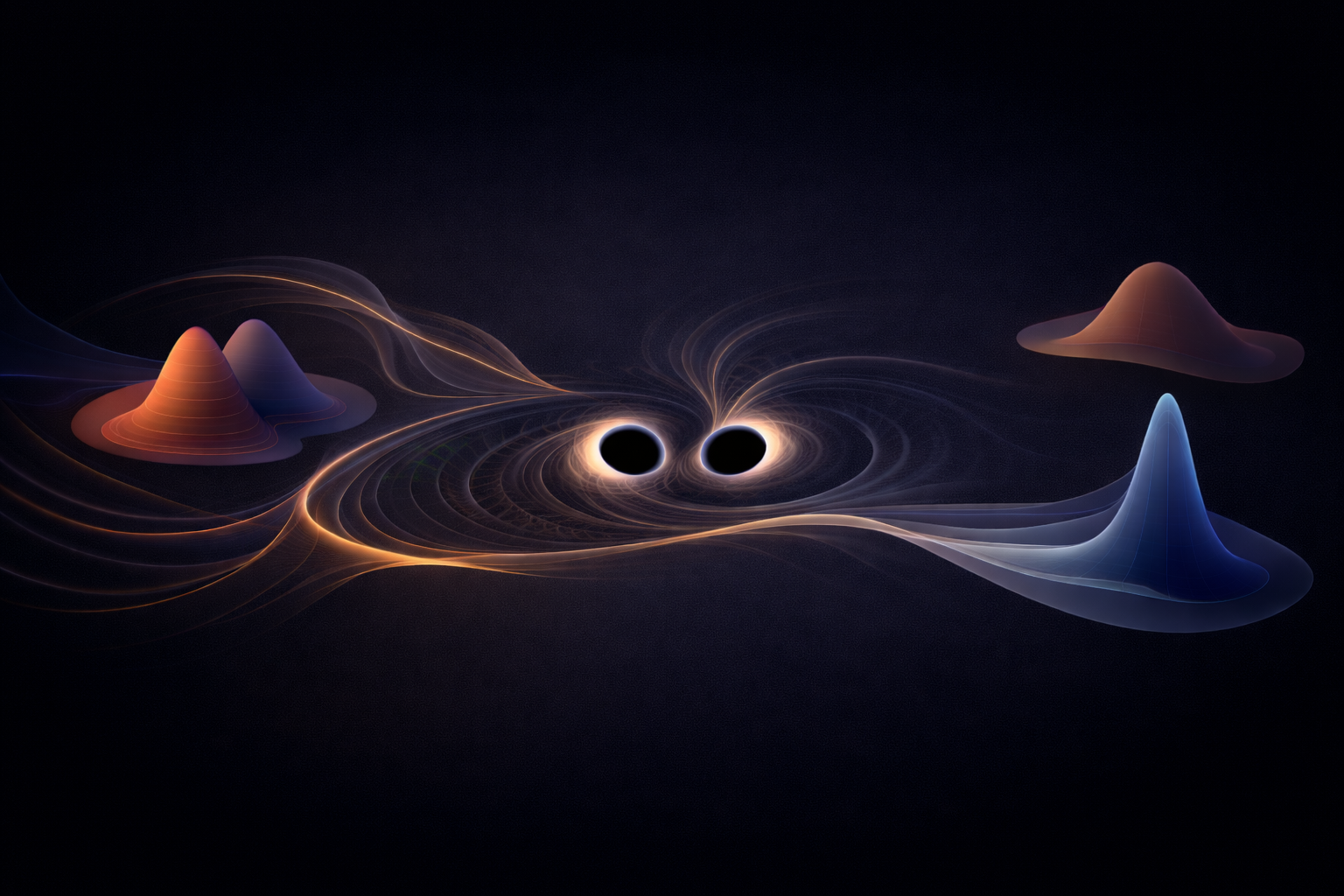
Image credit: AI-generated illustration (created with ChatGPT 5.2)